Jekyll2023-10-27T16:43:30+00:00https://spack.io/feed.xmlSpackAnnouncing public binaries for Spack2022-05-31T02:00:00+00:002022-05-31T02:00:00+00:00https://spack.io/spack-binary-packages
Spack was designed as a from-source package manager, but today users can stop waiting
for builds. Spack has been able to create binary build caches for several years, but
the onus of building the binaries has been on users: application teams, deployment teams
at HPC facilities, etc.
Today, enabled by some of the changes in
Spack v0.18, and helped by the
folks at AWS, Kitware, and the
E4S Project we’re starting down the path towards building binaries for
everything in Spack. Right now, we’ve got binaries for the following OS’s/architectures:
OS
Target
amzn2 (Amazon Linux 2)
graviton2
amzn2
aarch64
amzn2
x86_64_v4
ubuntu18.04
x86_64
You can also browse the contents of these caches at
cache.spack.io.
If you already know what you’re doing, here’s what you need to try out the 0.18 binary
release:
If you aren’t familiar with Spack binaries, we’ve got instructions for using these
binaries on graviton2 nodes below. Note that you do not need to have the Spack
v0.18 release checked out; you can use this cache from the latest develop branch,
too.
What’s different about Spack binaries?
Binary packaging isn’t new, and .rpm and .deb-based distributions have been around
for years, and conda is very popular in the Python world. In those distributions,
there is typically a 1:1 relationship between binary package specs and binaries, and
there’s a single, portable stack that’s maintained over time.
Traditionally, HPC users have avoided these types of systems, as they’re not built for
the specific machine we want to run on, and it’s hard to generarte binaries for all
the different types of machines we want to support. GPUs and specific microarchitectures
(e.g., skylake, cascadelake, etc.) complicate matters further.
Spack binaries are more like those used by Nix or Guix – they are caches of builds,
not specially prepared binaries, and installing a package from binary results in
essentially the same type of installation as building it from source. For determinism,
Packages are deployed with the dependencies they built with. One difference with Spack
is that we store considerably more metadata with our builds – the compiler,
microarchitecture target (using archspec),
flags, build options, and other metadata. We can use a single package to build all these
targets, and we can generate many optimized binaries from a single package
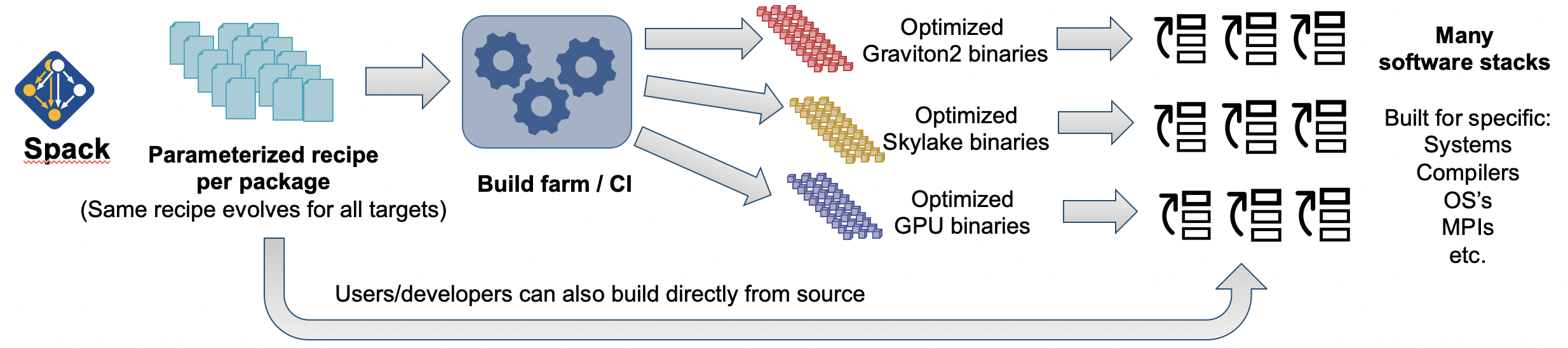
description. Here’s what that looks like:
With Spack, we’re trying to leverage our portable package DSL not only for portable
builds, but for optimized binaries as well. We can generate many optimized binaries
from the same package files and targets, and we can maintain many portable software
stacks using the same package descriptions. This reduces the burden on maintainers, as
we do not need to support many thousands of recipes – only as many recipes as we have
packages. And it is easy to assemble new software stacks on the fly using Spack
environments. Spack binaries are also relocatable so you can easily install them in
your home directory on your favorite HPC machine, without asking an admin for help.
CI for Rolling releases
To support combinatorial binaries, we are trying to push as much work upstream as
possible. We don’t want to have to spend a week preparing a new release, so we’ve built
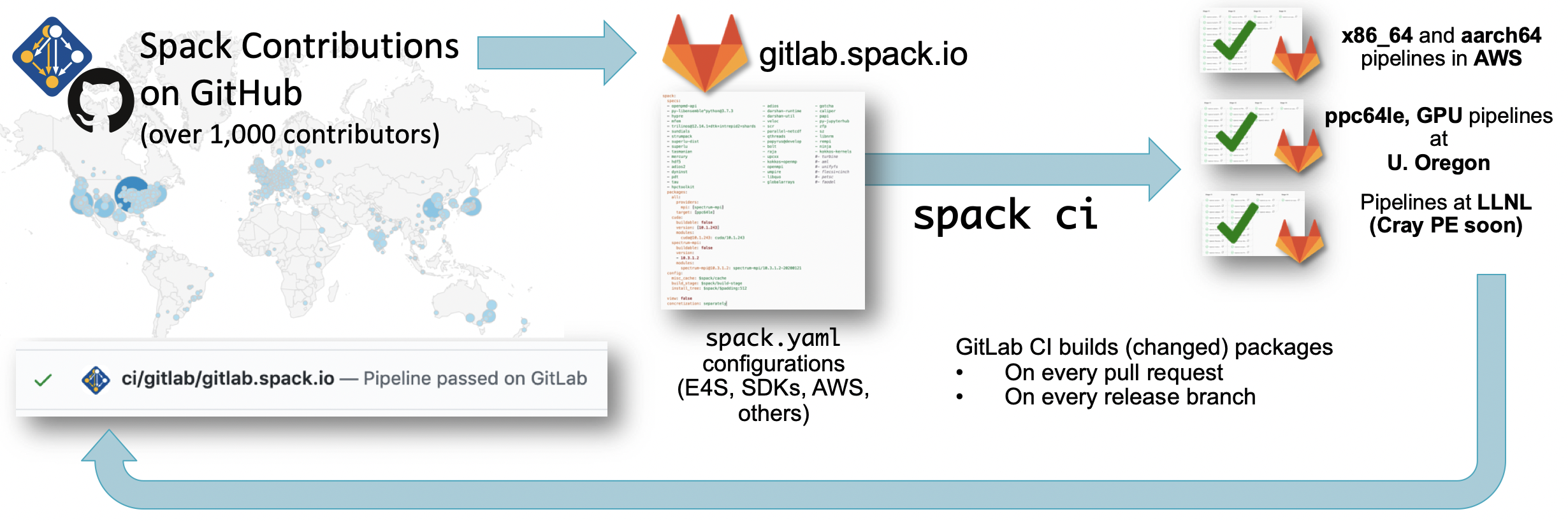
cloud automation around these builds. For every PR to Spack, we rebuild the stacks we
support, and we allow contributors to iterate on their binary builds in the PR. We
test the builds on different architectures and different sites, and if all builds
changed or introduced by the PR pass, we mark the PR ready for merge. This allows us to
rely on the largest possible group of package maintainers to ensure that our builds keep
working all the time.
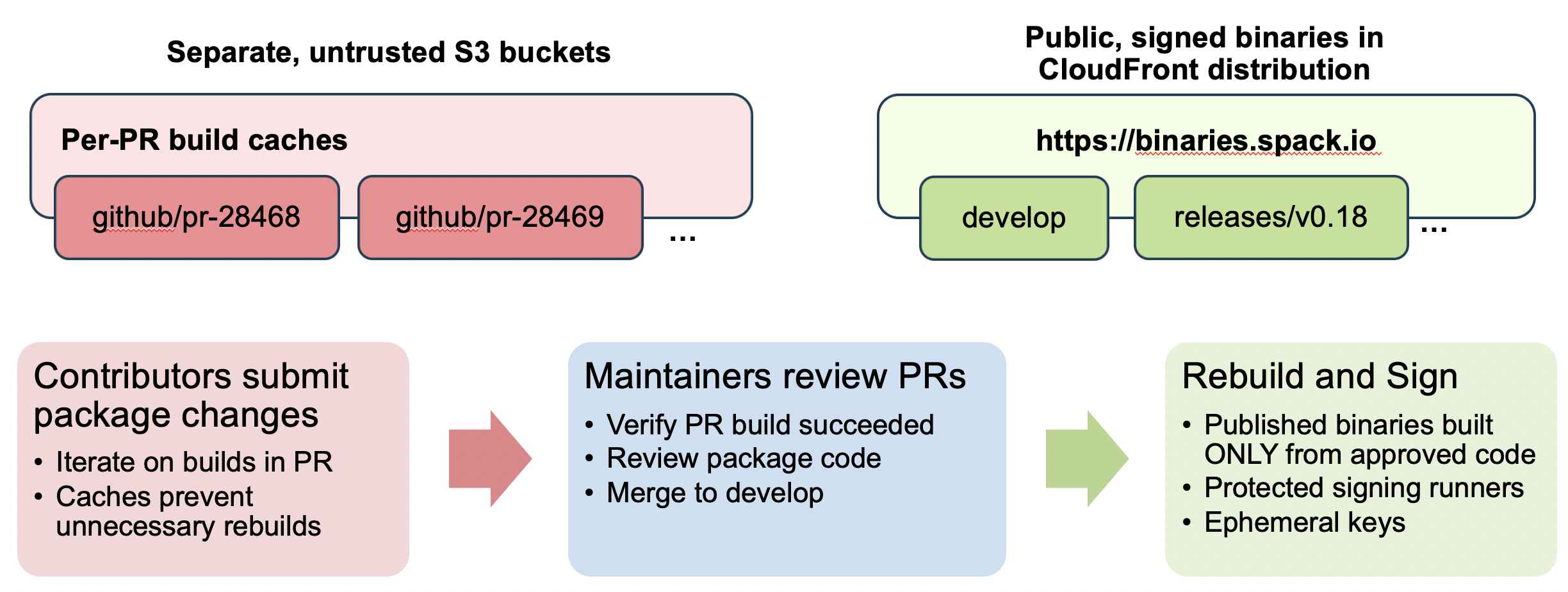
One issue with this approach is that we can’t trust builds done in pull requests. We
need to know if the PR builds work, but we may not know all contributors, and we
cannot trust things built before our core maintainers approve PRs. We’ve solved this by
bifurcating the build.
Every PR gets its own binary cache, and contributors can iterate on builds before any
maintianer has a chance to look at their work (though we do obviously have to approve CI
for first-time contributors). Contributors can work in parallel on their own stacks, and
per-PR build caches enable them to work quickly, rebuilding only chnanged packages.
Once a maintainer looks at the PR and approves, we rebuild any new binaries introduced
in a more trusted environment. This environment does not reuse any binary data from
the PR environment, which makes us sure that bad things from an earlier PR commit won’t
slip in through binaries. We do rebuilds for develop and release branches, and we
sign in a separate environment from the build so that signing keys are never exposed to
build system code. Finished, signed rebuilds are placed in a rolling develop binary
cache or in a per-release binary cache. You can find the public keys for the release at
spack.github.io/keys
Expanding the cache
This is only the tip of the iceberg. We are currently running 40,000 builds per week in
Amazon AWS to maintain our binaries, with help from the E4S project to keep them
working. Kitware is ensuring that our cloud build infrastructure can scale. You can see
stats from the build farm at stats.e4s.io.
We will be expanding to thousands more in the near future. Our goal is to eventually
cover all Spack packages, and to make source builds unnecessary for most users and
eliminate the long wait times between deciding on a simulation to run and your ability
to start a scientific simulation. Expect more compilers, more optimized builds, and more
pacakges.
Spack aims to lower the burden of maintaining a binary distribution and make it easy to
mix source builds with binaries. Packages available in the binary mirror will install
from binaries, and Spack will seamlessly transition to source builds for any packages
that are not available. Users will see approximately 20X installation speedups for
binary packages, and performance improvements for binary packaging are in the works.
Running Spack binaries in the cloud
On a brand new amazon-linux image, you can have optimized HPC applications installed
in only 7 commands. (If you already run Spack, it’s only 3 additional commands). You can
do this on a ParallelCluster instance if
you want to run these codes in parallel.
Let’s say you want to install gromacs.
First we need to get Spack installed. Spack has a couple low-level dependencies it needs
to be able to do anything, including a C/C++ compiler. Those aren’t on your image by
default, so you will need to install them with yum. sudo yum install -y git gcc
gcc-c++ gcc-gfortran
Now you can clone Spack from github and check out the latest release. Spack will
bootstrap the rest of what it needs to install the binary packages. You’ll also want to
setup the Spack shell integration so Spack is in your path and all its features are
available git clone https://github.com/spack/spack.git cd spack git checkout v0.18.0
. share/spack/setup-env.sh
Now you can configure Spack to use the pre-built binary caches. You can either point it
to develop or releases/v0.18.0
You can compare the public key that Spack downloads against the ones available at
https://spack.github.io/keys/ for an alternate source of truth to validate source of the
binaries.
Now you can download optimized HPC application binaries
spack install gromacs
Spack will install from binaries for any package spec that is available, and will
aggressively reuse binaries for dependencies. You can see what’s available with Spack
spack buildcache list --allarch
Anything that’s not available will still reuse the available packages for dependencies,
and will seamlessly fail over to building from source for any components for which
binaries are not available.
10 minutes in and your application is already available, now you can go on to do the
science you set out to do.
]]>Todd GamblinChanges to bootstrapping in Spack v0.172021-08-13T00:02:00+00:002021-08-13T00:02:00+00:00https://spack.io/changes-spack-v017Starting with Spack v0.17, the new concretizer will be the default, and Spack will automatically
install a new dependency (Clingo) from binaries. You can optionally disable this bootstrapping.
Spack and its own dependencies
Since its earliest releases, Spack has had
software requirements,
and we’ve tried to restrict them to very basic system requirements that you’d find on most
machines. A compiler, patch, make, etc. are commonly found on at least Linux and macOS systems,
and we’ve expected users to make them available themselves.
With Spack v0.16, we introduced an option to use a new concretizer (dependency solver), which is
based on Clingo under the hood. Clingo is a very powerful
Answer Set Programming system – it lets us solve the complex constraint problems among Spack
packages – all the versions, conflicts, feature requirements, optional dependencies, and
compiler/target compatibility issues are now handled by Clingo
(more here).
Using Clingo, we’ve been able to handle much more complex Spack environments, and we’ve been able
to fix issues where the old, greedy concretizer would fail on concretizable specs, or where it
would just make incorrect decisions. The new concretizer is more maintainable and allows us to
develop features rapidly.
It will enable us to more aggressively
reuse dependencies and to model more complex software
relationships in the future.
We’re making the new concretizer the default
In Spack v0.17, we will make the new concretizer the default, but that means that Clingo will be
a prerequisite, and it is not something most people will have installed by default. However, we
want Spack to be just as usable out of the box after this change. In particular, we want spack
install to work immediately after you clone Spack, just like it did before.
And we’re bootstrapping it from binaries
What we decided is that from v0.17 on Spack will, by default, install some of its dependencies
from a public buildcache of portable
binaries. The source code we use to create this buildcache is open and
hosted on GitHub. The bootstrapping procedure
will be transparent – the first concretization you do will just be slightly slower while the
binary packages are fetched from the buildcache and verified by their SHA256 checksum. It looks
like this:
$spack find -b==>Showing internal bootstrap store at "/home/spack/.spack/bootstrap/store"==>0 installed packages
$spack spec zlib
Input spec
--------------------------------
zlib
Concretized
--------------------------------
zlib@1.2.11%gcc@11.1.0+optimize+pic+shared arch=linux-ubuntu18.04-broadwell
$spack find -b==>Showing internal bootstrap store at "/home/spack/.spack/bootstrap/store"==>2 installed packages
-- linux-rhel5-x86_64 / gcc@9.3.0 -------------------------------
clingo-bootstrap@spack python@3.6
This default should preserve the “clone and run” simplicity in setting up Spack that you’re used
to.
What if I don’t want to use Spack’s binaries?
For those of you who do not want to use our public binaries, you can opt out of bootstrapping,
and Clingo will be built from source instead. To disallow bootstrapping from binaries, but still
permit Spack to bootstrap from sources, just run:
$spack bootstrap untrust github-actions
==>"github-actions" is now untrusted and will not be used for bootstrapping
To completely disable any bootstrapping, you can run:
$spack bootstrap disable
If you do this, you’ll need to ensure for yourself that Spack’s prerequisites are properly
installed. You can use this option, for example, if you know that Clingo is already installed
(e.g., using pip) in the python you’re using to run Spack.
For more details on how bootstrapping will work, you can check out the
pull request #22720. Also keep an eye on our
permanently-pinned issue for other high-impact
changes arriving soon in Spack develop.
]]>Massimiliano CulpoPodcast: Spack on CppCast2021-05-28T00:02:00+00:002021-05-28T00:02:00+00:00https://spack.io/cppcast-podcastThe CppCast podcast recently hosted Spack creator Todd Gamblin and core developer Greg Becker. They discuss a range of topics including an overview of the exascale computing landscape, documentation generators, floating-point numbers and performance standards, a new project focusing on ABI (application binary interface) compatibility, getting the most out of heterogeneous architectures, and of course Spack. The episode runs 59:13. Show notes and related links are provided on the episode page.]]>ECP annual meeting videos now available2021-04-22T00:02:00+00:002021-04-22T00:02:00+00:00https://spack.io/ecp-videosSpack is the software deployment tool of the Exascale Computing Project (ECP), a joint effort between the DOE Office of Science and NNSA that brings several together national labs. These combined forces tackle the hardware, software, and application challenges inherent in the DOE/NNSA’s scientific and national security missions. The ECP’s annual meeting was hed virtually this year on April 12-16. The agenda included two Spack sessions that are now available on YouTube:
Spack BoF (runtime 1:00:40): This “birds of a feather” gathering details major developments in Spack releases, collaborative work with the E4S team, roadmap for future development, and results from our community survey. The session was led by Todd Gamblin, Greg Becker, Tammy Dahlgren, Peter Scheibel, Richarda Butler, and Sergei Shudler.
Using Spack to Accelerate Developer Workflows (runtime 6:14:42): This tutorial focuses on developer workflows, covering covered installation, package authorship, Spack’s dependency model, and Spack environments and configuration. Participants can learn new skills in this tutorial, even if they have participated in Spack tutorials in the past. Presenters were Todd Gamblin, Greg Becker, Peter Scheibel, Tammy Dahlgren, and Rob Blake. See also Spack’s tutorial docs.
]]>Spack User Survey 20202020-12-02T00:03:00+00:002020-12-02T00:03:00+00:00https://spack.io/spack-user-survey-2020Introduction
Spack has been around for a while, and we’ve always felt like we have a
pretty good sense of the community through channels like GitHub, Slack,
and our Google group. However, the project is getting larger, and we
wanted to better understand the community’s needs with more structured
feedback. Spack is funded by the NNSAASC Program
and the U.S.
Exascale Computing Project (ECP), and we
wanted to understand the different needs of ASC, ECP, and other types of
users.
So, this year, we ran our first ever Spack user survey. Read on to see
the results.
About the survey
The survey has 26 multiple-choice questions and 6 longer-form questions.
It was open from September 28 to October 9, and there were 169
respondents. We advertised to the broadest audiences we knew how to
reach. Specifically, we advertised the survey through:
the ECP-wide mailing list (ECP is ~1,000 people); and
the El Capitan Center of Excellence (COE) mailing list.
There’s probably a lot of overlap between these lists, so this may not be
as wide an audience as it would seem. It’s probably biased towards U.S.
users, as the people on the mailing lists are very U.S.-centric. So,
while the sample is by no means scientific, we know at least that it
covers a lot of Spack users.
Data
The results are summarized here, but you can get the full data set and
the scripts we used to generate these charts
here. There are a lot of
results – let us know if you find anything interesting that we missed.
Thanks!
Thanks to the 169 users who filled out the survey, both for this feedback
and for your continuing contributions to Spack! This project wouldn’t be
possible without the community!
Demographics
In this section of the survey, we tried to understand the composition of
the Spack community.
ECP and Spack
The first question we asked was whether respondents were part of ECP.
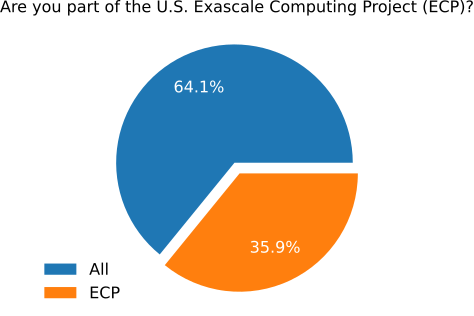
ECP represents just over a third of the community (~35%, or 61 of 169
respondents). It includes people from both sides of the U.S. Department
of Energy – NNSA laboratories like
LLNL, LANL, and
Sandia; and
Office of Science, laboratories like
ANL, ORNL,
LBL, PNNL,
BNL, and others. Under ECP, the Spack team is
focusing on delivering a software stack for the first U.S. exascale
machines, which includes upcoming systems like:
LBL’s Perlmutter: AMD CPU /
NVIDIA GPU (pre-exascale)
All of these are HPE/Cray systems, but the hardware is quite diverse
(particularly the GPUs). We wanted to see whether the users at the
bleeding edge of HPC had significantly different needs from the Spack
community as a whole. So, in most of the following sections, we present
responses for Spack and for ECP separately.
What kind of user are you?
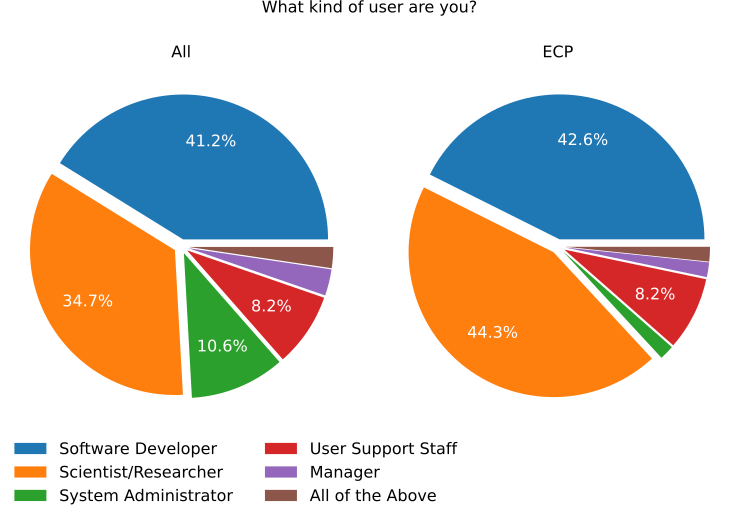
We asked users what their role was at their organization.
Spack was originally targeted at user support teams and system
administrators, but by far the largest parts of the community are end
users (scientists/researchers) installing software on HPC machines (35%)
and software developers (41%). System administrators were ~11% of the
overall community, and user support staff were only 8%. In ECP, this is
even more pronounced – only a small fraction of respondents identified
as system administrators, and developers were nearly 43% of the ECP user
base.
Part of the absence of sysadmins may be that at DOE labs, administrators
don’t typically handle installation of user software – that’s left to
dedicated support teams who engage with users. Admins (at least in DOE)
tend to focus on keeping the machines running and managing the host OS
underneath Spack.
If you compare this to
EasyBuild’s latest survey
(slide 13), you’ll see that the composition of the communities is very
different. In EasyBuild’s similar survey, only 3% of the respondents
identified as developers, and only 9% were scientists. User support and
admins were 26% and 53% of the EasyBuild user base, respectively.
Where do you work?
We next asked users where they work.
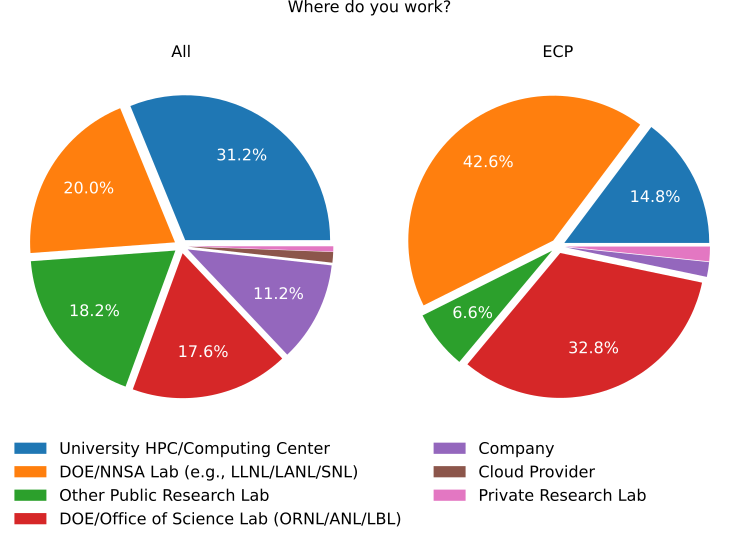
The community as a whole is diverse. Slightly less than a third (31%) are
from Universities. 37.6% are from DOE NNSA and Office of Science
laboratories (more than all of ECP – so parts of DOE not in ECP are
included). Other public research labs make up 18% of Spack users, and
~13% are from private companies and cloud providers. Within ECP, a large
majority of users (76%) were from DOE labs, but there was still some
participation from public labs and universities.
Comparing again with
EasyBuild’s survey
(slide 13), we can see that EasyBuild has a much smaller percentage of
users from national computing centers (13% vs. 37%), and a larger
percentage of users from universities (55%). It is hard to tell exactly
how the proportions compare, as EasyBuild’s survey provided a “university
research group” option, while in our survey that is likely spread across
the “University HPC center” and “public research lab” categories.
What country are you in?
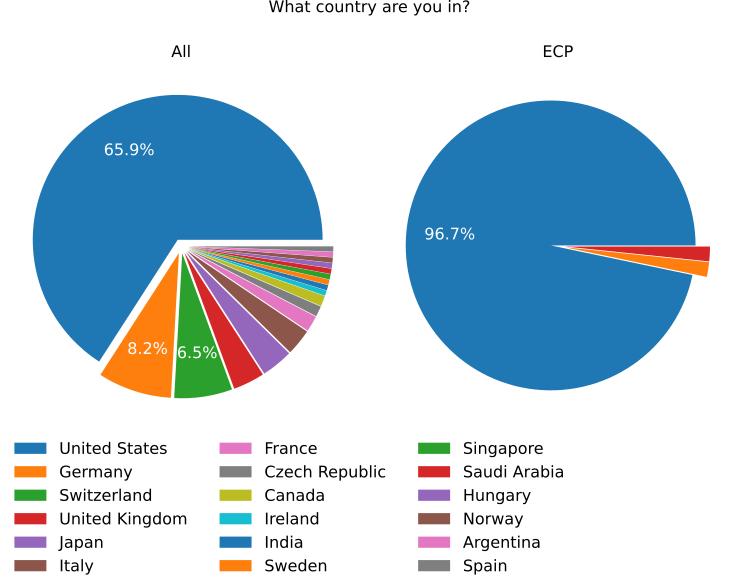
Just under 2/3 of Spack users are in the United States, and nearly
exactly 2/3 are from North America when our two Canadian respondents are
included. 27% are from Europe, 5% from Asia, and there was one respondent
each from the Middle East (Saudi Arabia) and South America (Argentina).
Within ECP (which is a U.S. DOE project), the proportion is much higher
– nearly 97% are from the U.S.
What are your primary application areas?
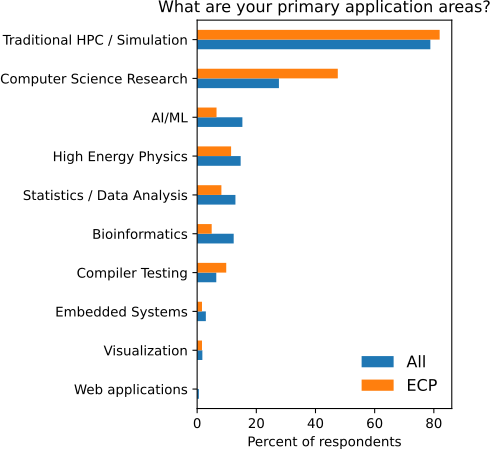
These results are mostly as we expected – most Spack users (~80%) are
doing traditional HPC and simulation. In the broader community around 30%
are doing computer science research, but within ECP around 50% are doing
CS research. In ECP, AI and bioinformatics were noticeably less emphasized
than in the broader Spack community. Interestingly, compiler testing was
the 7th most popular application area outside ECP, but the 4th most
popular inside ECP. Only one user reported using Spack for web
applications.
How did you find out about Spack?
Both in and outside ECP, about half of Spack users hear about the tool
via word of mouth. This result made us pretty happy – we think it means
that users are very willing to recommend Spack to friends. After word of
mouth, 22% people heard of Spack because it was used at their site.
Within ECP this was slightly more likely at 30%.
24% of users heard about Spack from outreach activities: tutorials, BOF
sessions, and presentations.
How long have you been using Spack?
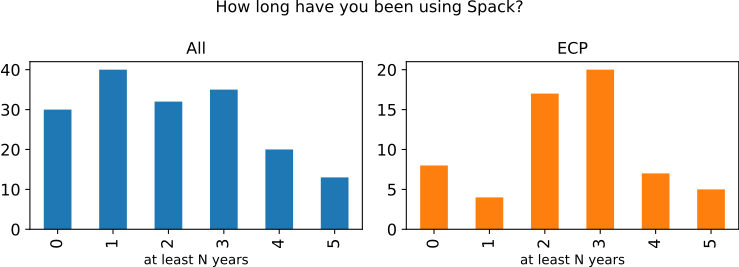
Spack usage has been growing over time, and the number of users who join
the community each year is increasing. Most of the overall community has
been using Spack for less than two years. We also see this effect in the
number of contributors to the project on GitHub. In 2018, after the
project had been publicly available for 4 years, there were around 300
contributors. 2 years later, there are nearly 700.
Within ECP, the community is older – most people started using Spack in
ECP 2-3 years ago. There has been less new adoption since then, which we
attribute to Spack’s rapid adoption in ECP. Spack caught on quickly
there, people have continued to use it, and there is not a large influx
of users into ECP. The population stays mostly the same over time.
Have you contributed to Spack?
Around 75% of users who responded have contributed to Spack in some way
or another, and most of those (60%) have contributed a package. Nearly
40% of users are active on Slack, and nearly 40% have filed issues on
GitHub.
It’s notable that Slack discussions are far more active than the Spack
mailing list – users seem to want to engage live rather than sending
emails back and forth.
Not many users (~10%) have contributed to documentation, but even this
small amount helps the project – this is around 16 people.
There don’t seem to be any special takeaways here for ECP, except that
ECP users seem to be slightly more likely to contribute a package (nearly
70% have done so).
Spack Usage
Having characterized the user base, we moved on to finding out how they
use Spack.
What version(s) of Spack do you use?
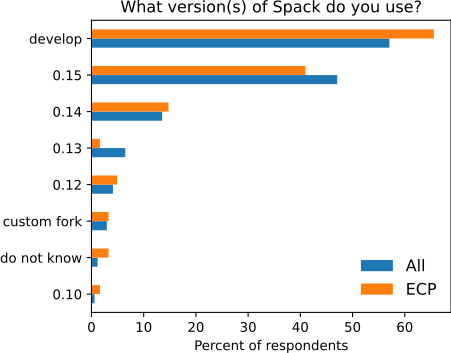
Spack users like to be on the bleeding edge, and it shows up the versions
of Spack they use. Just under 60% of users are using the develop branch
of Spack, and the number is higher (~65%) in ECP. The next most popular
version was 0.15, which was the latest Spack release at the time
of this survey.
Comparatively few users were on older versions, though a very small
number of people were using 0.10. A lot has happened since then – 0.10
was released in January 2017, and there were around 1,000 packages then
(vs. 5,000 now). We hope the users still on 0.10 will upgrade – both for
features and for package fixes.
What OS do you use Spack on?
OS's of Spack users ignoring (left) and considering (right) specific Linux
distributions.
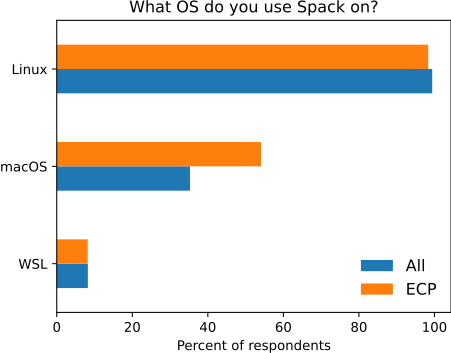
Spack is targeted at HPC, so it’s no surprise that nearly 100% of users
are using it on Linux. What users sometimes
forget is
that Spack also works on macOS. Around 35% of all users run Spack on
their macs, and over half the users within ECP are also running it on
macOS. A small number of users (<10%) are running Spack within the
Windows Subsystem for Linux. We don’t test there, but we’re told that
Spack works fine in the WSL environment.
If we look at the responses in more detail, we can see the specific Linux
distributions that users are running. The most popular, by far, are
CentOS and Red Hat. In ECP, Red Hat is especially popular. Ubuntu is the
next most popular after these, then macOS, then other Linux distributions
and WSL. SuSE is more popular within ECP than in the broader community,
likely because it is the Linux distribution that most Cray systems are
built on.
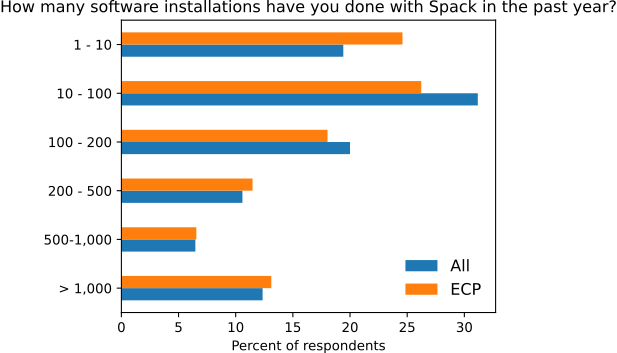
How many software installations have you done with Spack in the past year?
Almost 28% of the community has done over 200 software installations, and
over 12% have done over 1,000 installs. The ECP numbers are similar to
the general population, but the distribution is slightly shifted towards
larger numbers of installations.
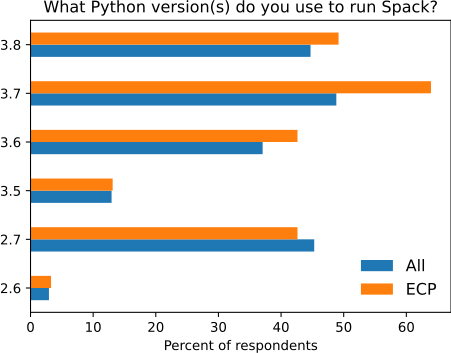
What Python version(s) do you use to run Spack?
Support for Python 2 ended January 1, 2020, but nearly a year later,
around 40% of Spack users are still using Python 2.7. 4 users are even
using Python 2.6. Python 2.7 is still the system Python version on many
operating systems, including Red Hat 7 and CentOS 7, and on Red Hat and
CentOS 6 (which are still used at some sites) the default is 2.6.
While many projects can pick their version of Python, Spack is often the
tool people use to install newer versions of Python, and we don’t want
to make users use another installer just to install Spack’s dependencies.
We want it to work out of the box, so we try to make Spack work with the
system Python everywhere.
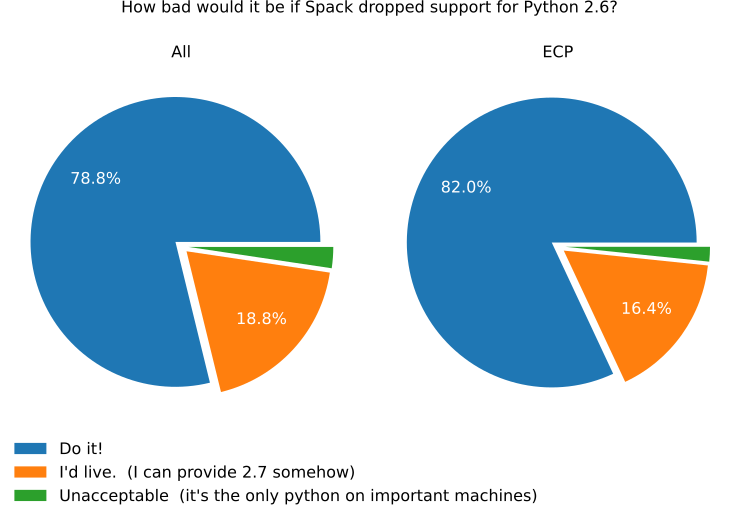
How bad would it be if Spack dropped support for Python 2.6?
We asked whether it would be OK for us to drop Python 2.6, and we found
that there are still around 4 hold-outs who really need Spack to work on
Python 2.6, and over 20% of people would be at least mildly
inconvenienced by this change. For the time being, we’ll keep supporting
Python 2.6, but you can probably expect its deprecation to be announced
sometime within the next year, as the last few Red Hat 6 installations
dwindle.
How bad would it be if Spack only worked with Python 3?
Eventually, we’d like to drop Python 2 entirely, but with 40% of users
still using 2.7, and with 36% of users likely to be bothered by the
shift, we’ll hold off on dropping 2.7, as well. Interestingly, while ECP
users were less likely than the broader community to completely oppose
dropping 2.6, they were more likely than the community to oppose
dropping 2.7.
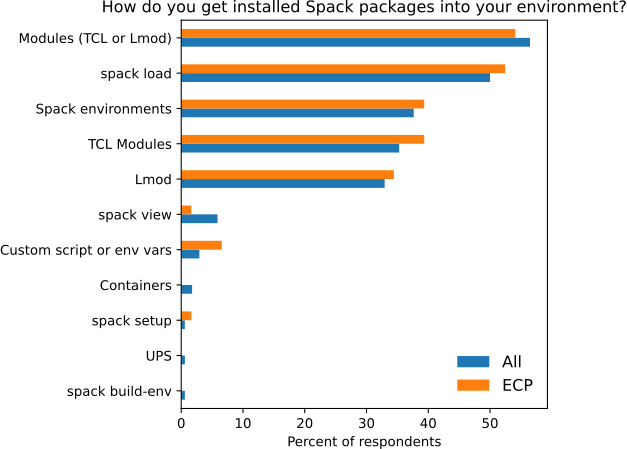
How do you get installed Spack packages into your environment?
The most common way to use Spack packages is still through modules, and
module usage seems to be split about evenly between Lmod and TCL modules,
with some overlap. We were surprised to see that the spack load command
is the second most popular way to use Spack packages, only a few
percentage points behind modules.
We don’t have data on past usage of spack load, but we’ve tried to make
it easy to use everywhere, and this may have caused its usage to
increase. In particular, in earlier Spack releases, spack loadrequired modules in order to work (it was a thin layer around module
load). As of
Spack 0.14 in
early 2020, it only requires Spack’s own environment support – so you
can easily load a one-off package on your mac or personal Linux box where
you don’t already have modules installed.
After spack load, around 35% of users are making use of Spack
environments to load groups of packages together. Like spack load,
Spack environments require no support from the module system – they work
regardless of where Spack is deployed and provide a more portable
alternative to loading environment modules.
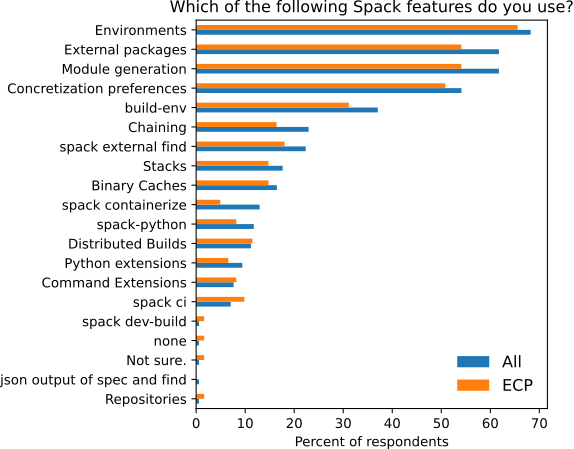
Which Spack features do you use?
While Spack
environments
ranked below modules for simply getting packages into PATH,
environments are actually the most widely used single feature of Spack
(at least on our list here). Around 2/3 of users say they use
environments. environments can be used to add packages to PATH, to
maintain a list of dependencies via spack.yaml, to version a
spack.yaml environment in a repo, to do
combinatorial builds,
to reproduce builds with spack.lock, to configure and run
CI pipelines,
and to
build container images.
Looking Ahead
We wanted to get a sense of what users will need from Spack in the coming
year, so we asked about upcoming architectures, Spack features, and
events.
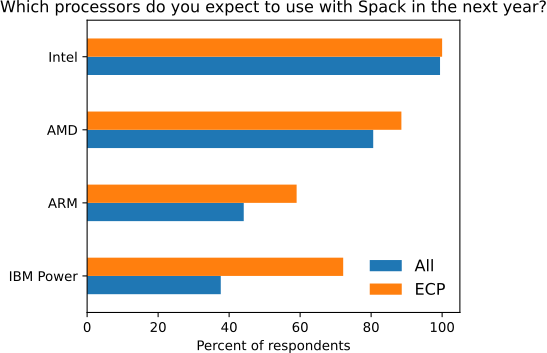
Which CPUs do you expect to use with Spack in the next year?
Nearly everyone in the Spack community plans to run on Intel CPUs in the
next year, and around 80% expect to use Spack to build for AMD systems.
Just over 40% of users will run on ARM and just under 40% will run on
Power. Within ECP, the percentage of users that want to run on any of the
non-Intel CPUs is larger – as you might expect, ECP is targeting a more
diverse set of architectures. There were many more ECP users who expected
to run on Power than in the broader community, likely because the current
top two U.S. systems, Summit and Sierra, are Power machines.
We can’t draw a fair comparison with EasyBuild on this question, as
EasyBuild’s survey asked users what CPUs they were currently using
rather than what they expected to be using in the next year, and their
survey was done a year ago, and things are changing fast in HPC. So, take
it with a grain of salt, but the difference is still worth mentioning. In
the
EasyBuild survey
(slide 26), the vast majority of users were similarly running on Intel
machines. But, less than 20% were using AMD chips, less than 5% were
using Power, and only one user reported using ARM. It’s likely their
numbers for AMD and ARM will increase on the next survey.
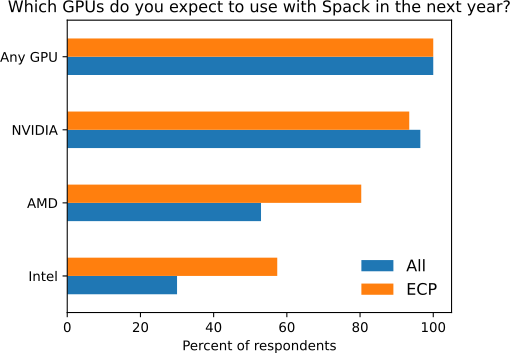
Which GPUs do you expect to use with Spack in the next year?
All users in the Spack community expect to run on GPUs in the next year,
and over 90% plan to build for NVIDIA GPUs. Around half of the overall
community expects to build for AMD GPUs, and around 30% expect to build
for Intel GPUs. Within ECP, the percentage of users planning to run on
NVIDIA GPUs is very slightly lower, likely because NVIDIA will not be the
GPU on any of the initial three exascale machines. Aurora will be an
Intel GPU system and both Frontier and El Capitan will use AMD GPUs. As
you might expect, 80% of ECP users expect to use AMD GPUs and over half
expect to use Intel GPUs.
GPU usage in the EasyBuild community
was similarly high – 96.5% of EasyBuild users were compiling software
for GPUs – so it’s pretty clear that GPUs have become pervasive in HPC.
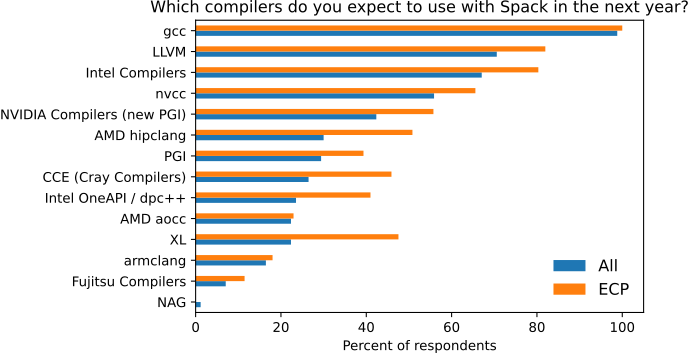
Which compilers do you expect to use with Spack in the next year?
As you might expect given the CPU and GPU results, Spack users
anticipate using a very wide range of compilers. gcc is still king,
with almost 100% of users expecting to use it, and LLVM and Intel
compilers are next on the list.
Interestingly, only around 60% planned to use nvcc, and a bit more than
40% planned to use NVIDIA’s HPC compilers. Given that over 90% of users
said they expected to build on NVIDIA GPUs, we’re tempted to explain the
discrepancy by saying that a large percentage of users expect to use
NVIDIA GPUs not through CUDA directly, but through GPU-optimized
libraries or through compiler capabilities like OpenMP offload. The same
can probably be said for AMD and Intel GPUs – the percentage of users
who plan to run with compilers specifically intended for these GPUs was
consistently lower than the number of users who anticipated using them.
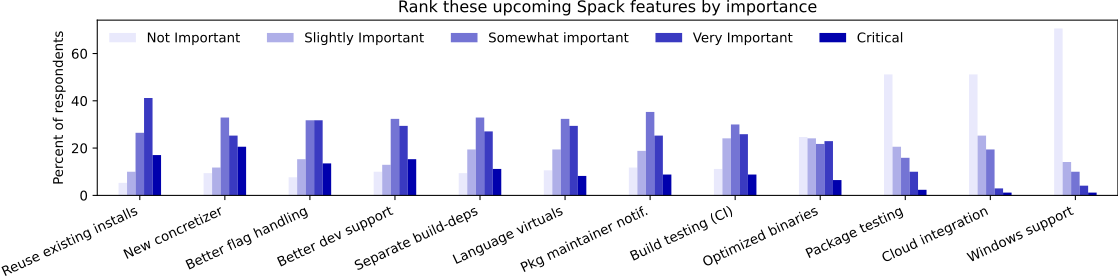
Rank upcoming Spack features by importance
We asked respondents to rank some planned and not-yet-planned Spack
features by importance: “not important”, “slightly important”, “somewhat
important”, “very important”, and “critical”. The two most frequently
ranked “critical” (and also the top two features by average score) were
reusing external installs and the new concretizer. These are related, as
the new concretizer is needed to reuse existing installations.
After those, the most important features were better compiler flag
handling and better support for developers. Separate concretization of
build dependencies (i.e., using gcc for packages like CMake even if the
user asked that the main package be built with the Intel compilers) was
next on the list, followed by language virtuals (ability to depend on
cxx, c, or fortran and have that resolve to a compiler and runtime
library), automatic package maintainer notifications on GitHub, and build
testing.
The features rated least important were build testing, publicly
available optimized binary packages, package testing, cloud integration
for Spack, and Windows support, with the last three rated significantly
less important than all the others.
Every feature was listed as “critical” by at least some users, but there
are some clear preferences here that we’ll be trying to tailor our
efforts to. We already shipped the new concretizer as an experimental
feature in
Spack v0.16.0, and
we’ve already merged a number of fixes for it in
Spack v0.16.1. Separate
concretization of build dependencies and reusing existing installs are
both modifications that we’ll need to make to the new concretizer, and
we’ve already started looking into how we can provide them. Better
developer support, language virtuals, maintainer notifications, better
build testing, and package testing are already milestones for 2021.
The feature that stands out that we haven’t yet worked into our plans is
better compiler flag handling. Based on this survey we’re going to see if
we can work that into our schedule for 2021, as well.
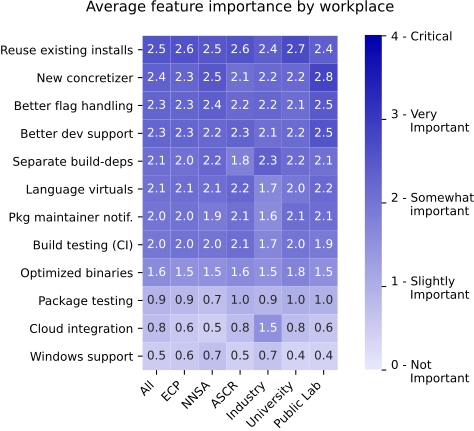
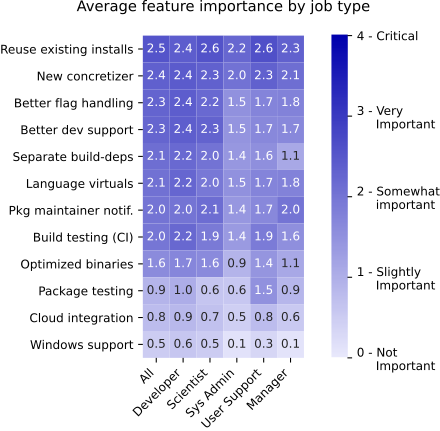
Feature ratings by workplace (left) and by job type (right).
In addition to the community-wide averages above, we looked at whether
different segments of the community rated features differently. On the
right above, we split out average feature ratings by workplace, and on
the left we split them out by job type.
Overall, the rank order of features was similar across different
workplaces and job types. Reusing existing installs and the new
concretizer were consistently at the top of everyone’s list, and the
lowest-rated features had low ratings across the board. Industry users
prioritized cloud integration noticeably higher than other groups, and
user support staff placed a much higher value on package testing than
other job types (perhaps because they are involved in more package
testing efforts at their sites). Managers and ASCR labs rated separate
build dependencies lower than other groups. Other than these outliers
there were not significant deviations from the overall order of
preference.
There are some noticeable trends across groups. System administrators,
user support staff, and industry users tended to rate features as less
important across the board. It’s hard to know how to interpret this – it
could mean that they’re happy with the existing capabilities of Spack, or
that these particular improvements aren’t their top priorities.
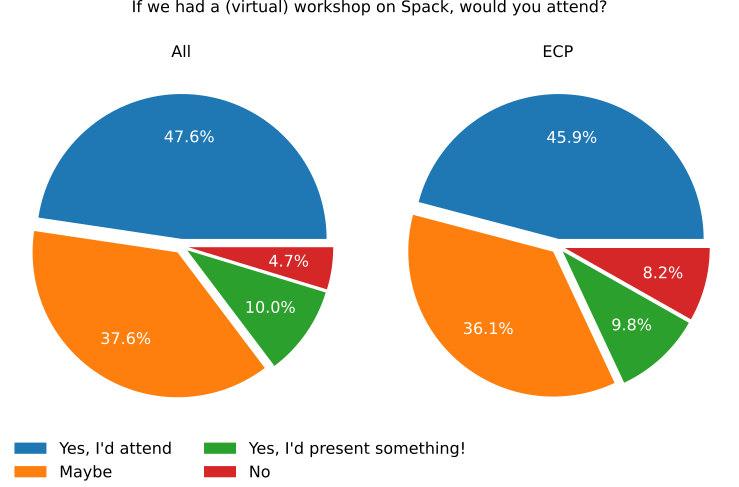
If we had a (virtual) workshop on Spack, would you attend?
We’ve thought about having a Spack user meeting for a while, and we had
actually started planning for an inaugural Spack User Meeting earlier
this year. That fell apart when the pandemic hit. Other similar tools
have had good luck with meetings like this (e.g.,
NixCon and the
EasyBuild User Meeting),
so we asked users what they thought of a potentially virtual meeting:
Just over half of users (over 85 people) said they would attend, and 17
said they’d be willing to give a presentation. That seems like more than
enough for an initial Spack meeting, so expect us to announce something
for 2021.
Getting Help
We’re interested in making it easier to learn about Spack, so we asked
people how they’re doing it now.
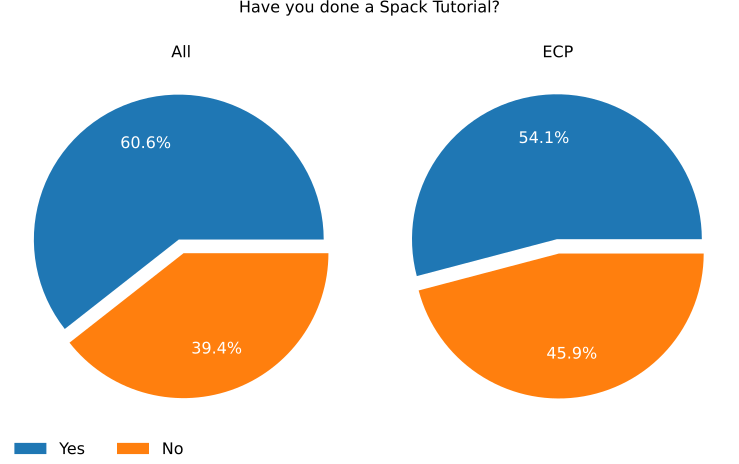
Have you done a Spack tutorial?
We were surprised to see that over 60% of all our users have done a Spack
tutorial. Since 2016, We’ve been doing Spack tutorials at conferences
like Supercomputing,
ISC, and
PEARC, and this
year we had over 125 attendees at our virtual
Spack tutorial on AWS. This seems
to show that tutorials have been a very effective form of outreach, even
if they aren’t the main way people first hear about Spack (per our
earlier question).
At the very least, they likely contribute to the
high rate of contribution
in the community.
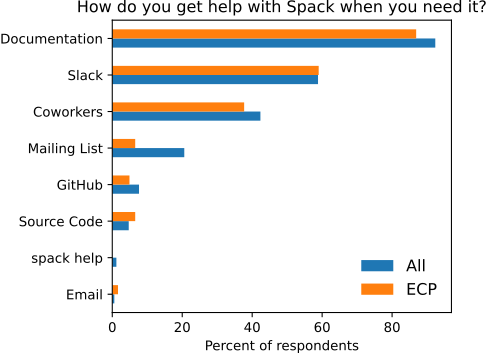
How do you get help with Spack when you need it?
Users go to the docs more than any other place for help with Spack.
Slack,
as mentioned above,
is also very popular – 50% of users use it to get help. We were happy to
see that around 40% of users get help from their coworkers, and when we
looked further at this data, those who got help from coworkers were not
confined to big laboratories – they came from
all the types of workplaces
that we considered.
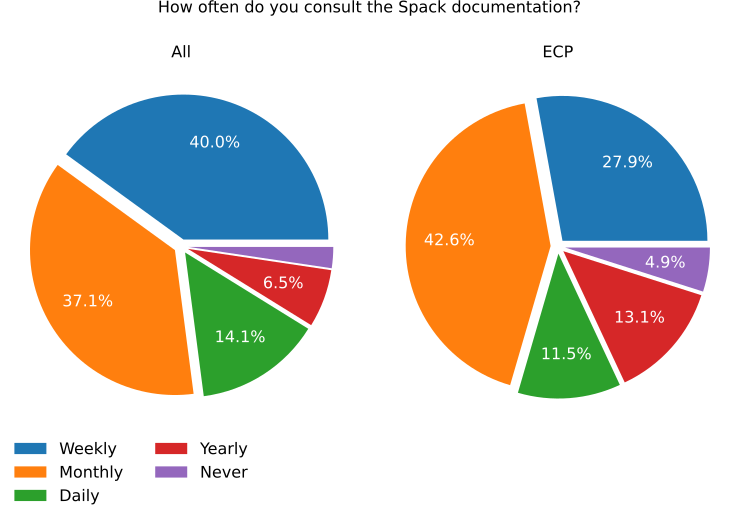
How often do you consult the Spack documentation?
Users consult the documentation reasonably frequently – weekly to
monthly for most. A small fraction (14%) check it daily. ECP users check
the documentation less frequently on average than the community as a
whole, but
ECP users have also been using Spack for longer,
and are likely more familiar with it.
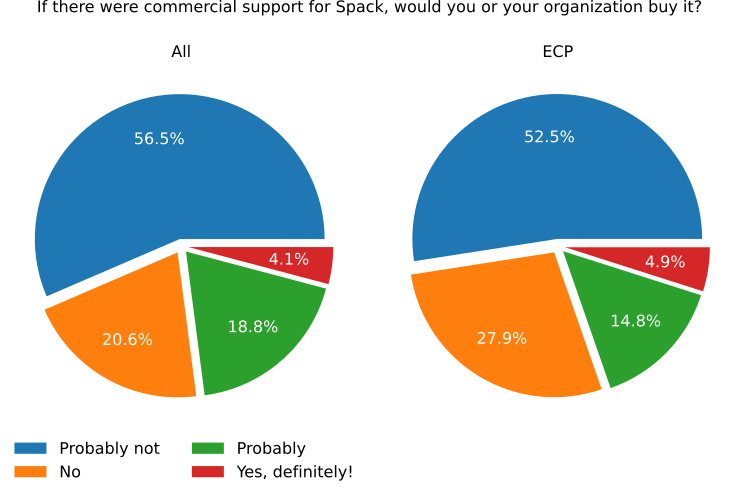
If there were commercial support for Spack, would you or your organization buy it?
We don’t have any plans to provide commercial support for Spack at the
moment, but it’s nice to know that 23%, or 39 users and their
organizations, might be willing to pay for it. That’s a fairly large
percentage of users willing to pay for support for an open source
product.
Quality of Spack
We wrapped up the multiple choice part of our survey with a final
question asking users to rate the quality of Spack.
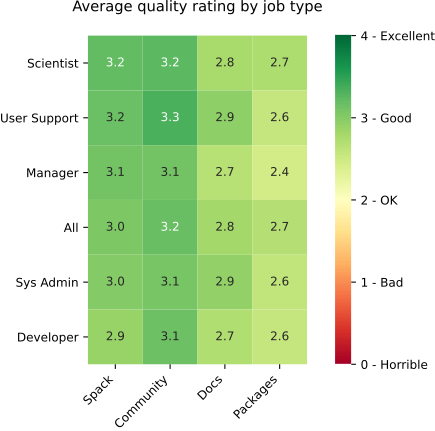
How would you rate the overall quality of Spack, its community, docs, and packages?
Similar to our
question on features
above, users were asked to rate different parts of Spack as “horrible”,
“bad”, “ok”, “good”, and “excellent”. We split the results out by
workplace and job:
Quality ratings by workplace (left) and by job type (right).
Responses were positive on average for all categories. Only 3.5% of users
responded negatively for the quality of Spack overall (cf.
2% for EasyBuild, slide 60). Only 5% responded negatively for any aspect. Consistently,
the highest-rated aspect was the community, which is great, because Spack
wouldn’t be sustainable without its community. Just after the community
was Spack itself.
While both the community and Spack averaged “good” or higher overall, the
docs and packages had the lowest average ratings. While some users have
praised the documentation,
a lot of documentation has accumulated and it likely needs to be
organized better. Spack targets
many different kinds of users,
and there is not just one workflow. We’ve gotten a lot of requests to
provide clearer how-to guides for common site deployment and developer
workflows, which is something we plan to work on over the next year.
Spack packages are a harder problem. The package DSL is part of what
makes Spack unique – there is one template for each package, and the
same template lets you build any version or configuration of a package.
This makes it easier to port Spack packages to new systems, but it also
makes the testing surface for Spack packages very large. We think we
are still on the right path, for several reasons:
Together with Kitware, we’ve built up a sophisticated CI system using
the support for
pipelines
built into Spack environments.
We’ve hooked up our GitLab instance to Spack’s main GitHub repository,
and within the next couple of weeks, we’ll be testing a subset of Spack
builds on every pull request.
One of our priorities for 2021 under ECP is hardening these builds and
testing Spack packages on a wide range of platforms, and now that the new
concretizer is in Spack, we expect to be able to steer Spack
configurations towards well-tested ones, based on builds in our pipeline
and under E4S. So, we expect package stability to get much better over
the coming year, and we’re hoping that it will show up in next year’s
survey responses.
Longer answers
We asked 6 long answer questions. If you want, you can read them all in
the data repository. The
number and length of responses to these was overwhelming, and we haven’t
come up with a great way to summarize them, but reading them all gave us
a great picture of what people in the community are up to. We’ve picked a
few responses per question and quoted them below.
Tell us briefly about your use case and your usual Spack workflow.
I am using Spack to build the software environment for our users on
our University’s centralized HPC system.
Using Spack to build complex applications natively. Moving the
build into containers, if possible with spack containerize.
We use spack to provide 3 consistent entry points into our nuclear
physics software environment: cvmfs, build_caches, containers.
Rather heterogeneous cluster with an environment per architecture.
Currently having lots of fun packaging bioinformatics tools.
Support Spack in Fugaku
I’m a math library developer and use spack to build third party
libraries e.g., blas, lapack, MPI, hypre, SuperLU_MT,
SuperLU_DIST, PETSc, and Trilinos both for developing on my
laptop and for continuous integration on a dedicated workstation.
We use spack to install most facility-provided software on OLCF HPC
machines.
Distributed build system with Spack environments
What about Spack helps you the most?
The community
Greg Becker responding to my questions on Slack.
How Spack handles installation of multiple versions of the same app.
How Spack should be Linux OS agnostic (yet to be tested) so we can
experiment with offering other distros for users.
Absolute flexibility, especially compared to, i.e., nix. And
dependency handling, which I never want to do manually again.
I’m still in dependency hell, but Spack took me from the 7th circle
(violence - for the violence I’d like to commit against my keyboard
while building things) to the 3rd circle (gluttony - for the
voracious appetite I now have for spack-installed packages and the
indulgent number of dependencies they require).
Well-defined package specifications and solid concretization.
The concretizer (despite some issues) is the most helpful aspect of
Spack. It allows for automatic dependency management and
reproducibility.
What are the biggest pain points in Spack for your workflow?
surprising re-concretizations, updating environments and removing old
packages
inter dependencies with many variants makes a huge/complicated
package file
Better parallel building of environments. I think Slurm integration
could be very good to have.
Right now, the time it takes to concretize in our deployment with ~2000
packages already in the database.
Not having language virtual dependencies makes it harder to have
language polyfills for newer features when the compiler doesn’t support
them. It also is hard to say what compiler versions you support
c++ language standard dependencies, build dependency blow-up
It seems that we should specify external package path every time so it
would be great if Spack can detect preinstalled libraries.
What’s the biggest thing we could do to improve Spack over the next year?
Keep doing outreach efforts, videos, tutorials, hackathons, whatever to
spread the voice more.
Python as a virtual dependency
The complaint I still have to field from people is “I tried to build a
simple package, and Spack built Python and CMake and and and and…” so
I think better deciphering of externals (which I know you’re working on
as we speak) would be good.
QA: less features but really solid CI on tagged releases, including
packages.
Cross compiler support, new concreteizer
Documentation organisation, examples, and explicit API listing of all
internal functionality.
New concretizer, maintainer bot
Build lots of buildcaches for each site to speed up builds. It could be
nice to have a cloud repository could be AWS, GCP, where spack host all
the buildcaches.
Fully-working backtracking concretizer
Don’t lose momentum.
Are there key packages you’d like to see in Spack that are not included yet?
Probably new build system support like Julia / Golang
I would like to be able to contribute one day adding the Uintah
software suite
moose
WRF. I’m aware that it’s now included in develop branch.
None that we haven’t been able to rapidly write for ourselves.
Do you have any other comments for us?
This project makes me enjoy coming into work.
Yes, I like spack, can’t do without it now.
It would be great if https://github.com/spack/spack-configs
included more DOE machines and were updated more frequently. If the
administrators at computing centers provide these files somewhere it
does not seem to be well advertised to users.
Pretty much every year my biggest victory with Spack is “they fixed the
thing that was biggest gripe about Spack last year,” which is a sign of
a really good job listening to users, so keep that up.
Keep up the good work. I will continue using and supporting Spack for
many years to come.
Keep being awesome! Spack is my favorite tool of the last 5 years!
It’s easy to create a real tangle of versions and special builds. I
think the project should work to maintain good communication with the
application developers, so that standard or common/expected versions and
dependency sets can be more clearly identified
Spack is extraordinary and blows away all past attempts to bring
sanity to HPC software. I encourage you to offer commercial support.
Please have support tiers that allow us to select an appropriate
level of support.
]]>Todd GamblinSpack featured on The Next Platform2020-11-12T00:02:00+00:002020-11-12T00:02:00+00:00https://spack.io/spack-featured-next-platformThe Next Platform provides in-depth coverage of high-end computing at large enterprises, supercomputing centers, hyperscale data centers, and public clouds. Against the backdrop of the Supercomputing (SC20) conference, the article titled “Spack Packs Deployment Boost for Top Supercomputers” describes the challenges of creating and deploying scientific software packages. Writer Nicole Hemsoth explains how Spack seeks to fill gaps in customization and configurability; that it is the deployment tool for Fukagu, the world’s top supercomputer; and, heading into the exascale era, how the Spack development team is handling the growing complexity of dependency issues for HPC software.]]>Spack at SC202020-10-15T00:03:00+00:002020-10-15T00:03:00+00:00https://spack.io/spack-at-sc20Supercomputing 2020 (SC20) runs for two weeks beginning on November 9.
See below for a list of our events.
Be sure to follow
@spackpm on Twitter for updates!
The tutorial provides a thorough introduction to Spack’s capabilities: installing and authoring packages,
integrating Spack with development workflows, and using Spack for deployment at HPC facilities.
Attendees will leave with foundational skills for using Spack to automate day-to-day tasks,
along with deeper knowledge for applying Spack to advanced use cases.
11:30am - 12:45pm (live)
Join the Spack Community BOF
and ask our developers anything. The core team will give updates on the community, new features, and
the roadmap for future development. We will poll the audience to gather valuable information on how Spack
is being used, and will open the floor for questions. All are invited to provide feedback, request features,
and discuss future directions. Help us make installing HPC software simple!
]]>Todd GamblinSpack R&D 100 award featured in LLNL magazine2020-08-03T00:02:00+00:002020-08-03T00:02:00+00:00https://spack.io/spack-rd-100-award-featured-llnl-magazineThe July issue of Lawrence Livermore’s magazine Science & Technology Review features Spack as one of the Lab’s four winning technologies from 2019. The article titled “Software Installation Simplified” covers Spack’s origins, mechanisms, key features, and thriving open source community. The magazine issue also has a commentary by LLNL’s deputy director for science and technology, who describes the awards in the context of the Lab’s culture of innovation.]]>Working remotely: the Spack team2020-05-16T00:02:00+00:002020-05-16T00:02:00+00:00https://spack.io/bssw-working-remotelyWith much of the tech sphere working from home right now, a Better Scientific Software blog post describes the Spack team’s experience working remotely. The Spack team has had to make some adjustments without being able to hold face-to-face tutorials and attend events in person, but there are a lot of online communication opportunities (e.g., Slack) to keep the community connected. A big difference-maker is having robust documentation so users can help themselves.]]>Podcast: Let’s Talk Exascale2020-04-28T00:02:00+00:002020-04-28T00:02:00+00:00https://spack.io/ecp-podcast-episode-67The Exascale Computing Project’s Let’s Talk Exascale podcast has a new episode featuring Spack: “Flexible Package Manager Automates the Deployment of Software on Supercomputers”. Todd Gamblin describes Spack’s role in the ECP’s software stack, the Spack-related events at SC19, and the R&D 100 Award. The converation covers what it’s like to work with Spack’s open source community and the version 0.13 release (now updated to v0.14). Episode 67 runs 5:54 and includes a transcript.]]>